Why We Built Spyline: Competitive Intelligence for the Rest of Us
Spyline didn't start in a brainstorm. It started with the same scene repeating at every company we've worked at: finding out about competitor moves from customers.
Before Spyline, our founder worked as an automation engineer at BHIVE Workspace, one of Bengaluru's biggest coworking and managed-office companies. The job was internal tools — not sales, not marketing. Which meant a front-row seat to conversations the role wasn't part of, and those conversations are why this product exists.
The same scenes kept repeating:
- Someone from the growth team walking in with news that a competitor had opened a new centre in a micro-market we were still “evaluating” — and now the question wasn't whether to respond but how late we already were.
- Founders asking, mid pricing discussion, “what are they charging for virtual office plans right now?” — and someone opening six websites on a laptop, reading out numbers that may or may not have been updated that quarter.
- A client conversation going sideways because a competitor had an offer on seats that nobody in the room had heard of. Until the client mentioned it.
None of this happened because people weren't smart or weren't trying. It happened because watching competitors is everyone's concern but nobody's job. The information was all public — pricing pages, announcements, job posts, sitemaps. We just found out late, every time.
You rarely lose because the other company is better. You lose because they moved first and you found out too late.
The absurd state of “keeping an eye on competitors”
When we started digging into this problem seriously, we set up the standard toolkit and watched it fail.
Google Alerts catches press releases.It's free and it works — for the things a competitor wantsyou to know. The quiet price revision, the plan that disappeared from their website, the new landing page for a campaign they haven't announced? Invisible.
Page watchers cry wolf. Tools that diff web pages are honest — they tell you something changed. Then they tell you that forty more times a week: a cookie banner, a rotating testimonial, a date stamp. By week three you stop opening the alerts. The one that mattered sits unread between two cookie-banner notifications.
“I'll check their websites every Friday” is a promise nobody keeps. Friday always has other plans. Manual monitoring is the gym membership of go-to-market: everyone signs up, nobody goes.
The serious tools are priced for another world.Klue and Crayon — the enterprise platforms built exactly for this — are genuinely good. They also run $15,000–20,000 a year (₹13–17 lakh), sold through sales calls, designed for companies with a dedicated product-marketing team maintaining battlecards full-time. For an Indian startup or a mid-size business, that's not a tool, that's a hire you didn't plan for.
So the market offers free tools that miss the point, cheap tools that drown you in noise, and excellent tools priced for enterprises. The middle — where most founders, operators and growing businesses actually live — was empty.
What we actually wanted (so we built it)
We didn't want a dashboard. Every team we've seen already ignores four dashboards.
We wanted one email a day that reads like a sharp analyst wrote it: here's what changed across your competitors, here's what it probably means, here's what you should do about it. And silence on days when nothing mattered.
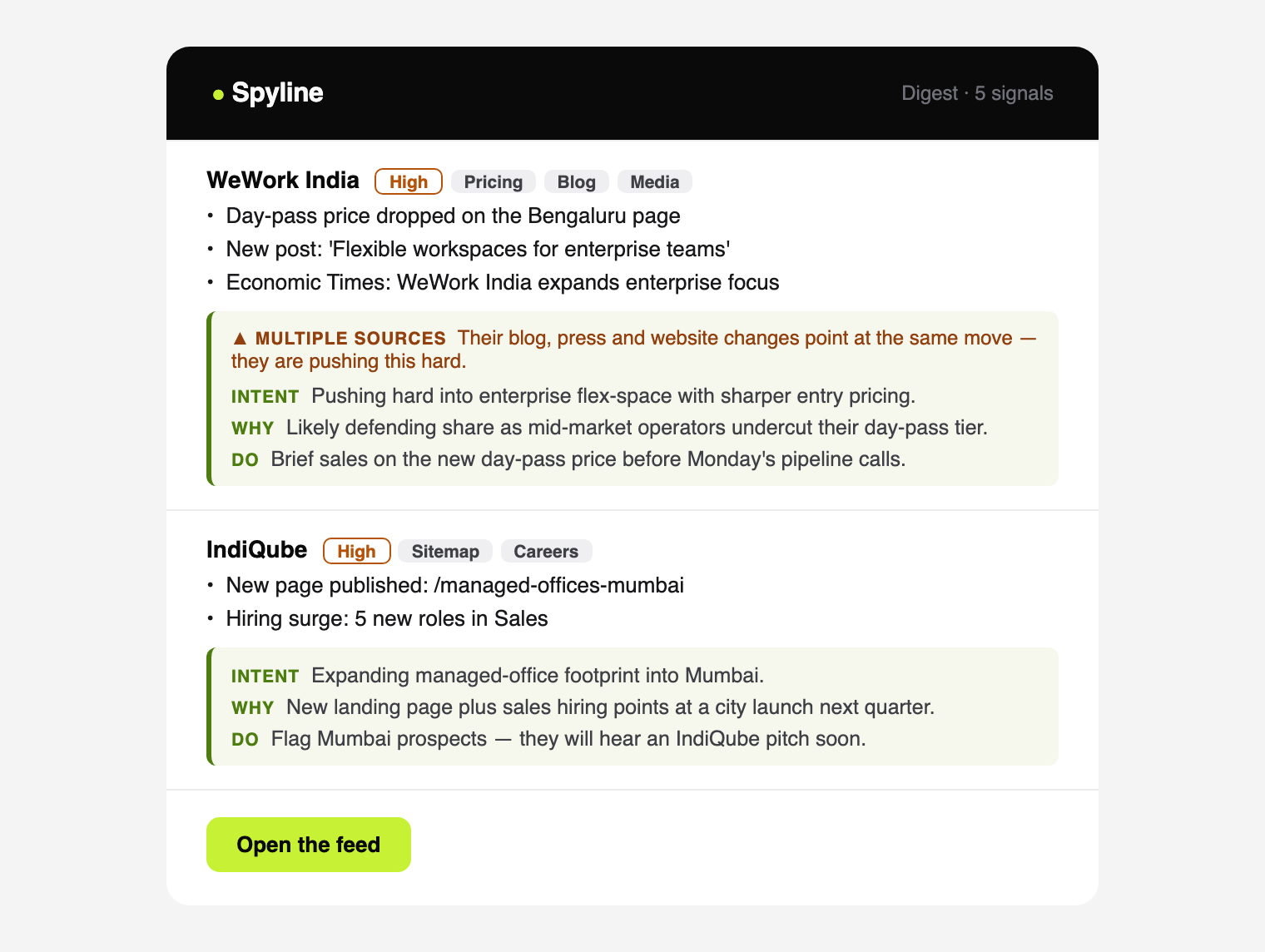
That's Spyline. You type in your company and your competitors — it suggests them if you're not sure — and it does the rest:
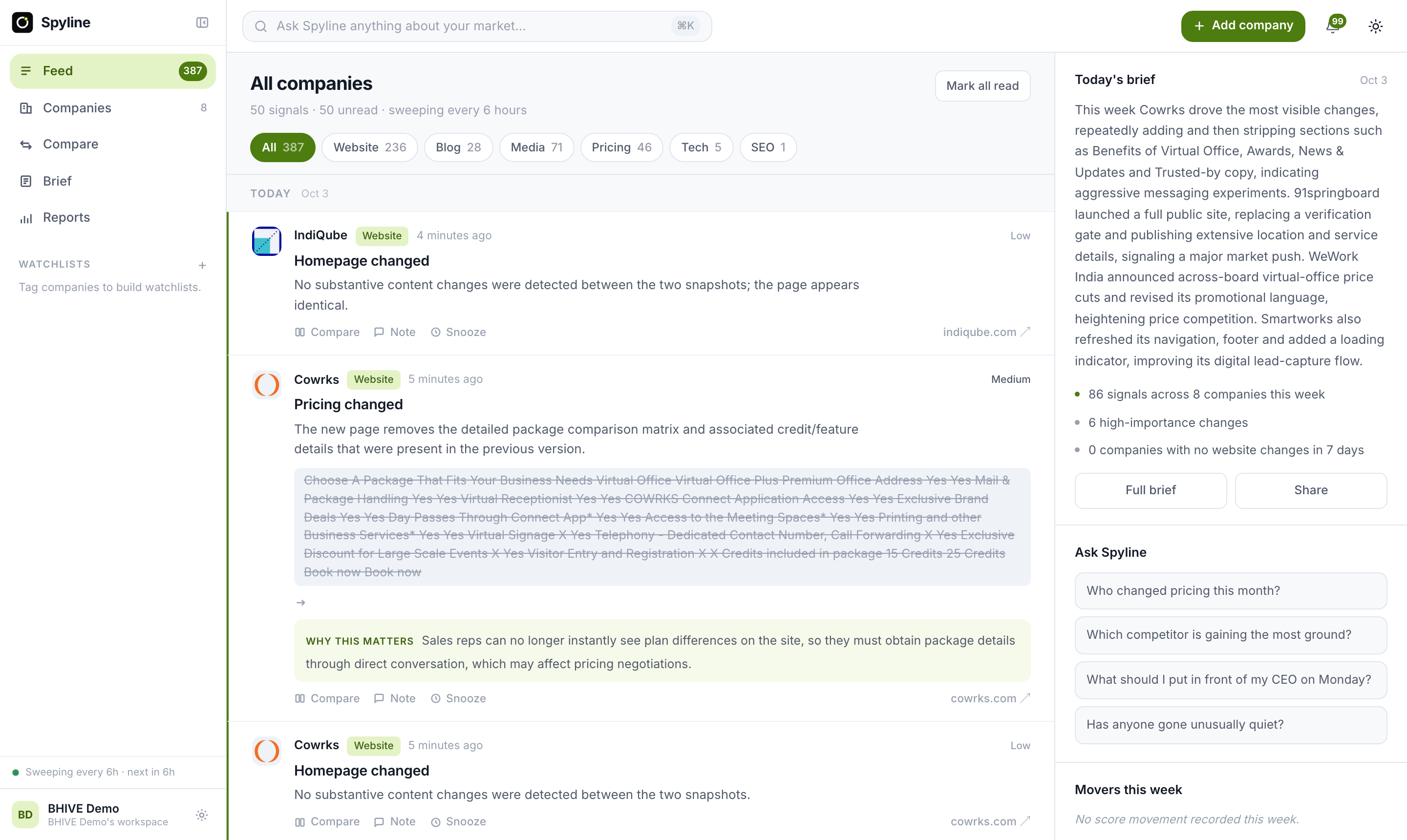
- Watches everything: their websites, pricing pages, blogs, newsrooms, new landing pages, press coverage, job boards, tech stacks, even new subdomains.
- Throws away the noise. Every detected change goes through an AI relevance check before it reaches you. A cookie banner is not intelligence. A deleted pricing plan is.
- Tells you what it means. Each day's digest groups signals by competitor and attaches an INTENT (what they're likely doing), a WHY (what they're trying to achieve), and a DO (the move it suggests you make).
- Keeps receipts. Dated screenshots of their pages, with the changed regions marked — so “they changed their pricing” comes with before-and-after evidence.
- Answers questions. Ask Spyline “what did our competitors change on pricing this month?” and it answers from your actual tracked data.
- Writes the battlecard. How to position against a specific competitor, generated from live data — no product-marketing hire required.
Who this is actually for
We built it first for SaaS founders — if you're in competitive B2B software, your rivals ship weekly and your investors ask “what about X?” monthly.
But the first weeks of real users taught me something: everyone has competitors, and almost nobody watches them properly.Spyline's earliest users include a conversation-intelligence startup tracking six rivals, a fintech watching the tax-software space, a voice-AI company — and a speech therapy clinic in Bengaluru. A clinic. Competitive pressure doesn't care what industry you're in. If someone else sells what you sell, their pricing page is worth watching.
Three things building this taught us
1. Detection is 20% of the problem. Diffing a web page is a weekend project. Deciding whether the diff mattersis the product. Most of Spyline's engineering goes into what we throw away.
2. Nobody wants another dashboard.Every user we interviewed had abandoned a beautiful dashboard. The inbox is the only dashboard with a 100% daily open rate. So the product's real UI is one email.
3. Short names will humble you.We track a company called “Balto.” Search the news for that name and you mostly get a famous sled dog. Every article now gets AI-verified as actually-about-the-right-company before it reaches a user.
Where this goes
Competitive intelligence is splitting into two worlds. The old one — quarterly research decks, hand-maintained battlecards, enterprise contracts — works if you have the team and the budget. The new one is continuous: systems that watch, filter and interpret all day, so a human only steps in when something needs a decision. The question isn't whether competitor monitoring becomes automated — it's who makes it accessible beyond the enterprise.
That's the job we've taken up: competitive intelligence for the rest of us. Not ₹15 lakh a year. Not forty noisy alerts a week. One sharp email a day. We're building Spyline bootstrapped from Bengaluru, and it's free to start.
If your team has ever found out about a competitor's move from a customer — we built this for that exact moment. Start free — setup takes five minutes, and Spyline finds your competitors for you.
Stop finding out from customers
Spyline watches your competitors and emails you what changed, what it means, and what to do. Free to start.
Start free→